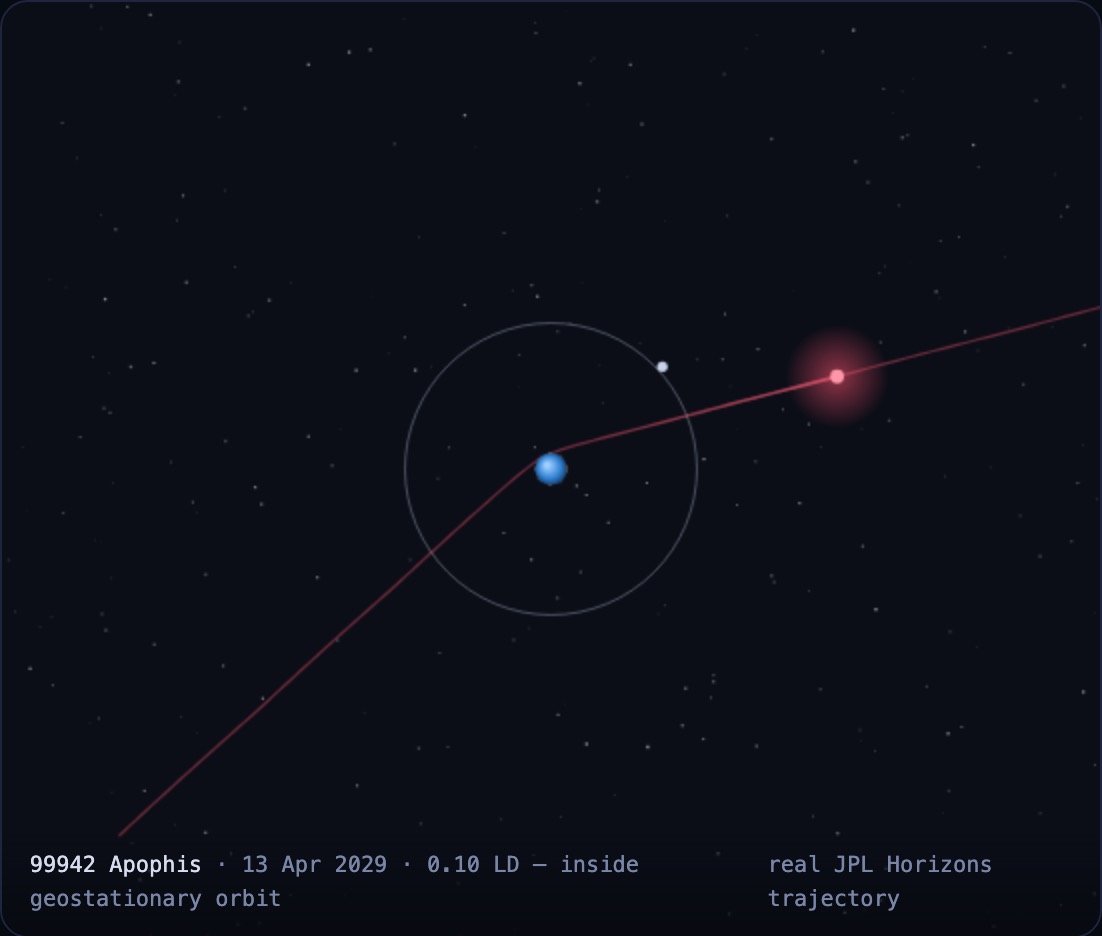
Most NEO pages draw ellipses from textbook two-body math and hope for the best. Asteroid Tracker renders the actual ephemeris — so what you see is what JPL computes.
◎
True-to-JPL flybys
Near every close approach, positions come from JPL Horizons full N-body ephemerides — the drawn pass hits the catalogued miss distance. Watch Apophis thread the geostationary ring at 0.10 LD, exactly where it will really be.
☄
Flyby cinema
Motion trails, closest-approach flashes, and a shrinking T− ring on the next pass. Press play and watch a week of rocks sweep past in seconds.
◉
Lunar-distance scale
Zoom in and the Moon's orbit and the GEO ring appear — the frame in which "how close?" actually means something. Earth itself rides its real elliptical orbit.
◐
Tiltable 3D view
Shift+drag lifts inclined orbits out of the ecliptic. Apophis's 2029 path bends 27° around Earth — visible, measured, labeled.
★
The watchlist
Every known sub-lunar pass out to 2100 — Apophis 2029, 2001 WN5 2028, 2005 YU55 2075 — loaded and framed whether or not they're in the current window.
☀
Will I see it?
Every asteroid page turns the flyby into your sky: where to look, when, how bright — naked eye, binoculars or telescope — computed by JPL Horizons for your own location.
◔
Honest uncertainty
Every pass is drawn with its 3σ corridor, every orbit with its quality code, and every object with the date it was first seen — including the ones found only after they had already passed.
◉
The blind spot & the feed
The daylight wedge where ground telescopes can't look is drawn on the map, and the Minor Planet Center's confirmation page streams in live: rocks spotted hours ago, not yet named.
⚠
Risk & fireballs
JPL Sentry impact-risk flags with odds and Palermo scale, plus recent atmospheric fireball detections — the small ones that don't miss.